The Advantages of Utilising Modular Docking for Bridge Repairs
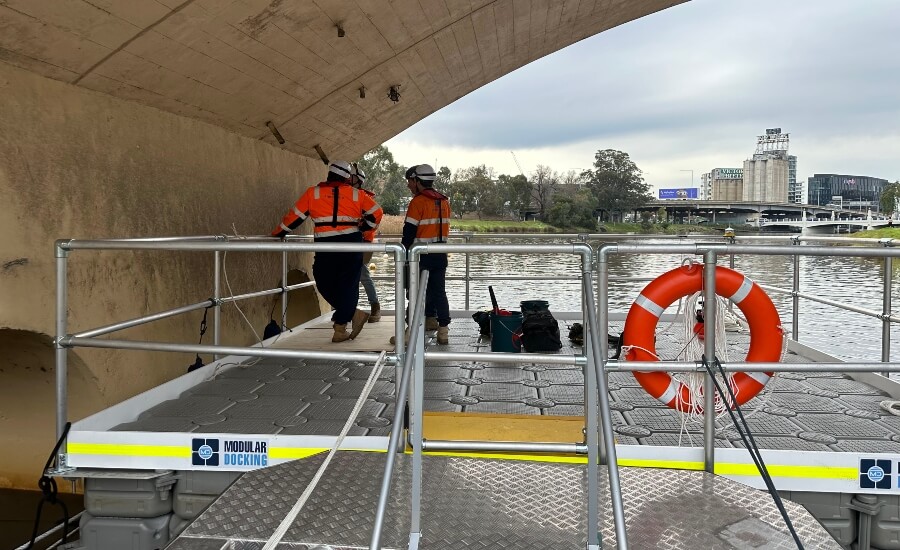
Bridge repair windows are tight, access is tricky, and safety is non-negotiable. Modular docking—interlocking floating pontoons configured to suit your work zone—provides contractors with a fast, stable, and compliant platform directly beneath the structure. Here’s why it’s become the go-to solution for bridge repairs, inspections, and utility installs across Melbourne’s waterways.
Why Modular Docking Works for Bridge Repairs
- Rapid mobilisation: Sections are trailered or transported in, assembled on site, and adjusted as the scope evolves.
- Stable, non-slip work surface: Purpose-built decks with tie-down points support tools, light plant and materials.
- Integrated safety: Edge protection, access control and compliant lighting are straightforward to add.
Flexible in Shape and Size
Every bridge geometry is different. Modular docks can be:
- Scaled to fit the task — from compact inspection rafts to multi-bay platforms for plant and crews.
- Shaped to the structure — L-shapes, U-shapes or wrap-arounds to follow abutments and soffit lines.
- Reconfigured mid-project — add or remove modules as you progress through spans and bays.
Build a Large Platform Under the Bridge & Around Piers
Working directly beneath the deck reduces rope access and eliminates many road closures. With modular docking, you can:
- Create continuous work zones under the soffit for patching, coatings, anchors and services.
- Wrap-around piers to inspect, repair, or install scour protection and utilities at the waterline level.
- Support EWPs/scaffolding (engineered) by reinforcing specific modules for point loads and outreach.
Handrails & Kickboards for Safer Edges
Edge protection is essential over water. We can fit:
- Handrails (typically 1.0 m) to define safe perimeters and manage public interfaces.
- Kickboards (typically 100 mm) to prevent tools and materials from dropping into the waterway.
- Gated access points for controlled boarding and emergency egress.
Practical Benefits On Site
- Minimised public disruption: Work from the water instead of closing lanes.
- Better productivity: Tools and materials stay at deck level, right under the work face.
- Cleaner environmental footprint: Good housekeeping, bunding, and spill kits are simpler on a defined deck.
- Traffic management made simpler: Clearly marked floating work zones with compliant lighting and signage.
Typical Use Cases
- Bridge inspections & minor remedials (soffit patching, joint repairs).
- Utilities installs (conduits, cable trays, services under deck).
- Pier works (concrete repairs, jackets, scour protection).
- Access for survey & geotech (sampling, coring, dive support).
Planning Checklist
- Load & stability: confirm deck loadings, point loads and freeboard under maximum load.
- Mooring & movement: spud poles or mooring plan for current, wind and vessel wash.
- Safety: rescue boat coverage, life-saving appliances, lighting, comms.
- Environmental: bunded fuels/hydraulics, spill kits, debris capture, and silt control, as needed.
- Approvals: waterway permits, traffic management plan, SWMS/JHAs and inductions.
How Melbourne Boat Hire Can Help
We deliver a turnkey package for commercial boat hire and barge/pontoon hire:
- Modular docking configured to your bridge geometry (including handrails & kickboards).
- Workboats and rescue boats stand by with AMSA-certified crew.
- Engineering support for load/stability, plus documentation and Traffic Management Plans.
- Optional integrations: EWP-ready modules, tool lockers, lighting, signage and branding.
Planning bridge repairs or inspections? Let’s scope a modular docking solution that keeps your crew safe, productive and on program—on the Yarra, Maribyrnong, and across Victoria.

